
Introduction: Understanding the “E” on Your Calculator
If you’ve ever used a scientific or graphing calculator, you’ve probably noticed an “E” or “e” symbol. It may seem confusing at first, but don’t worry—it’s not a mistake. The “E” in calculators stands for exponent, and it’s used to represent scientific notation. In this guide, we’ll break down what the “E” means, how it works, and why it’s an essential tool for calculations in science, engineering, and math.
What Is “E” on a Calculator?
The “E” on a calculator refers to scientific notation, which is a shorthand way of writing very large or very small numbers. It’s a method that helps represent numbers in the form of a base number and an exponent. For example, rather than writing out a very long number like 100,000,000, we can write 1E8, which means 1 × 10^8 (1 followed by 8 zeros).
How It Works:
When you see E on a calculator, it separates the base number (which is between 1 and 10) and the exponent. This makes it easier to work with extremely large or small values, which you’ll encounter in subjects like physics, chemistry, and engineering.
Why Is “E” Used?
1. Simplifying Large Numbers
Without scientific notation, very large numbers can be cumbersome and difficult to read. For instance, if you were calculating the speed of light (299,792,458 meters per second), instead of writing all the zeros, you can use scientific notation: 2.99792458E8. This makes it much easier to write and work with in calculations.
2. Managing Small Numbers
Similarly, extremely small numbers, like the size of a cell or the mass of an electron, can be represented more easily. For example, instead of writing 0.0000000000000000000000000000000000000000000000000001, you could use 1E-46. This is much easier to manage in equations and formulas.
3. Quick and Accurate Calculations
Calculators use E to handle exponents efficiently. It simplifies the process, especially when calculating very large or very small values that are common in advanced mathematics and scientific work.
How to Read and Use “E” on Your Calculator
On most scientific calculators, E represents “× 10^”, followed by the exponent. Let’s break it down with examples:
Example 1: Large Number (Positive Exponent)
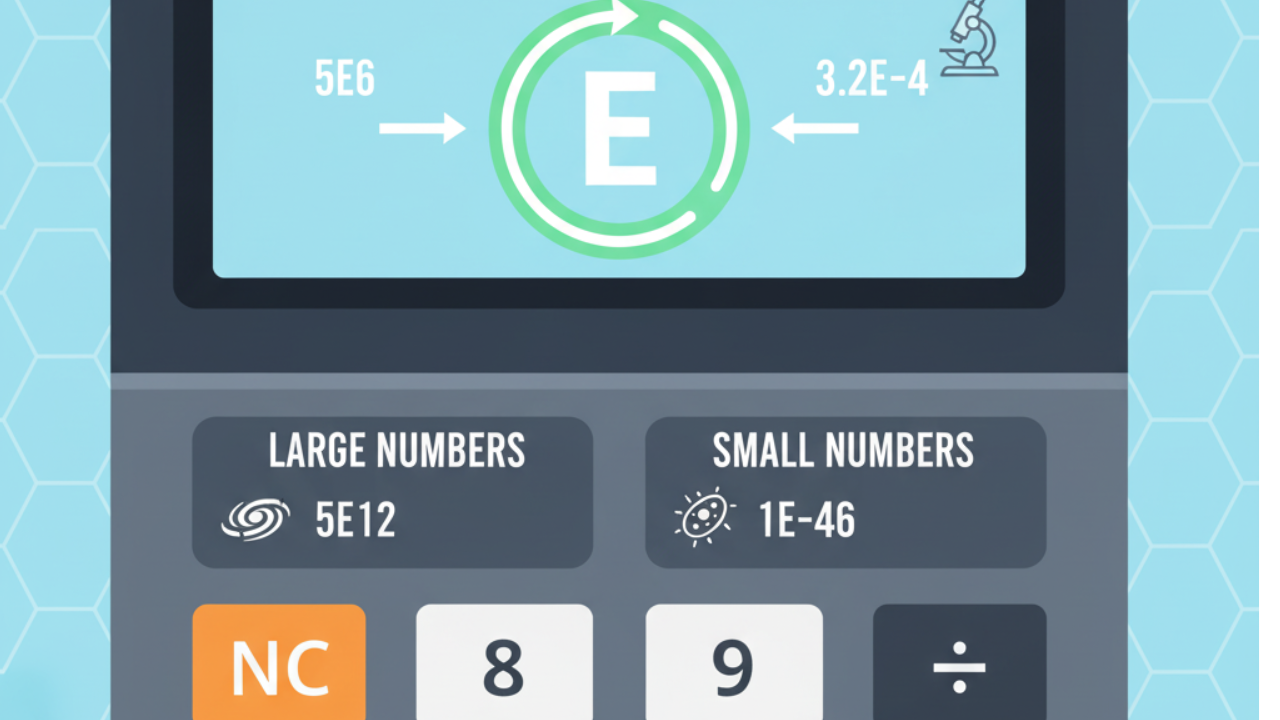
If you enter 5E6 into your calculator, this is equal to:
5 × 10^6, or 5,000,000.
This is much easier to work with than writing out all six zeros.
Example 2: Small Number (Negative Exponent)
If you enter 3.2E-4, this represents:
3.2 × 10^-4, or 0.00032.
In this case, the negative exponent tells you how many places to move the decimal point to the left, making it easier to work with tiny values.
The “E” Symbol in Different Calculators
While the E symbol is standard on most scientific calculators, some graphing calculators or programming tools might display e in a slightly different way, sometimes as a lowercase letter. It’s important to know that both E and e are used to indicate exponents in scientific notation.
In scientific calculators, you might see something like this:
-
2E3 = 2 × 10^3 = 2000
-
3.5E-2 = 3.5 × 10^-2 = 0.035
In graphing calculators, you may find it more commonly displayed in lowercase e:
-
2.5e3 = 2.5 × 10^3 = 2500
-
1.2e-5 = 1.2 × 10^-5 = 0.000012
How Does “e” Work in Different Scenarios?
1. What Does “e-4” Mean on a Calculator?
When you see “e-4”, it means the number is multiplied by 10 to the power of -4. The negative exponent tells you to move the decimal point to the left. Specifically, it means the number is very small.
For example:
-
2e-4 means 2 × 10⁻⁴, or 0.0002.
-
0.5e-4 means 0.5 × 10⁻⁴, or 0.00005.
In general, an e- followed by a number indicates that the decimal moves left, making the number smaller.
2. What Does “e+4” Mean on a Calculator?
Conversely, “e+4” means the number is multiplied by 10 to the power of 4. The positive exponent means the number is large, and the decimal moves to the right.
For example:
-
3e+4 means 3 × 10⁴, or 30,000.
-
1.25e+3 means 1.25 × 10³, or 1,250.
An e+ followed by a number indicates that the decimal moves right, making the number larger.
3. What Does “e12” Mean on a Calculator?
When you see “e12”, it means the number is being multiplied by 10¹², or 1 trillion. This makes the number very large.
For example:
-
5e12 means 5 × 10¹², or 5,000,000,000,000 (5 trillion).
Calculators use this notation to handle extremely large numbers quickly and easily.
4. What Does “e-7” Mean on a Calculator?
Similarly, “e-7” refers to 10 raised to the power of -7, or 0.0000001. It’s used for extremely small numbers.
For example:
-
3e-7 means 3 × 10⁻⁷, or 0.0000003.
-
1.1e-9 means 1.1 × 10⁻⁹, or 0.0000000011.
This notation helps represent tiny values without writing many zeros.
Common Mistakes with “E” on Calculators
1. Confusing “E” with “e”
While both E and e represent exponentiation, the lowercase e is often used to represent the mathematical constant Euler’s number (~2.71828), which is the base for natural logarithms. It’s crucial to differentiate between E (scientific notation) and e (Euler’s number) to avoid confusion.
2. Not Using the Correct Exponent
When you input a value like 3E2 and get 300 but expect a different result, it’s important to double-check the exponent. Make sure that the number following E is the correct one (positive or negative) and that it matches the intended calculation.
3. Overlooking the Negative Exponent
Don’t overlook negative exponents! For example, entering 4E-2 may seem like a typo, but it’s actually a valid entry that equals 0.04 (4 × 10^-2).
Practical Applications of “E” on Calculators
1. Scientific and Engineering Calculations:
-
Used to simplify complex calculations in physics, chemistry, and engineering.
-
Helps handle measurements of large forces, astronomical distances, or microscopic particles.
2. Financial and Statistical Calculations:
-
Useful for large financial models, such as GDP calculations, inflation rates, or investment growth over time.
-
Statistical models also use scientific notation when dealing with large data sets.
3. Everyday Use in Education:
-
Students often encounter “E” when learning about scientific notation in high school or college-level mathematics, physics, or engineering courses.
Conclusion: Mastering “E” on Your Calculator
Understanding the “E” symbol on your calculator is key to performing calculations efficiently in many scientific, mathematical, and financial fields. The E symbol represents scientific notation, a method used to simplify extremely large or small numbers, making it easier to perform calculations with extremely large or small values.
Whether you’re working with large numbers in physics or dealing with small values in biology, E simplifies the process and ensures quick, accurate results. With a firm grasp on how E works, you’ll be able to tackle complex equations with ease.
Disclaimer:
The information provided in this article is for educational purposes only. The “E” symbol is explained based on common usage in scientific and financial calculators. For professional or medical calculations, always consult an expert or use specialized tools designed for specific fields.