
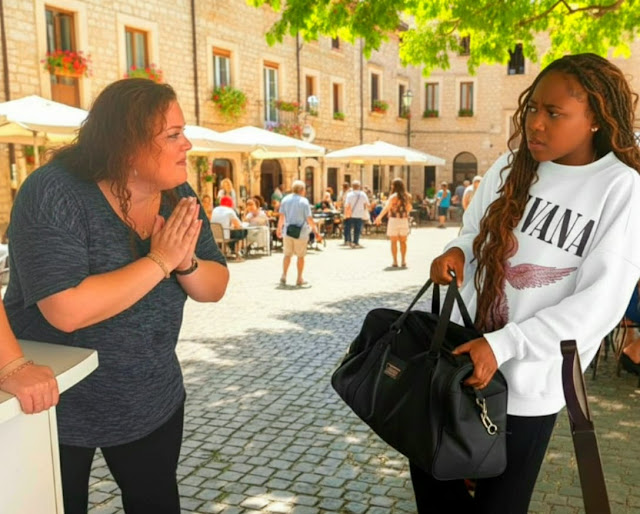
When an Apology Becomes a Battle Between the Heart and the Ego ✨
Have you ever found yourself overthinking every word you said to someone?
That’s exactly where Bethany finds herself, lost in a storm of doubt, replaying every interaction with Brooke. Every sentence. Every tone. Every moment.
She keeps asking herself, “Did I treat her right?”
And that question doesn’t come quietly. It echoes.
The Weight of Self-Reflection
Guilt has a way of whispering truths we try to ignore.
Deep down, Bethany feels that she may not have been as kind or patient as she should have been. There were sharp words. Moments of impatience. Subtle judgment. And now? They sting her memory.
But here’s the real struggle:
Is she apologizing because she truly feels sorry… or because she wants to clear her own conscience?
That blurred line between sincerity and self-preservation is where things get complicated.
The Fear of Being Misunderstood
Bethany knows something important — words alone aren’t enough.
An apology can either heal or feel hollow. And she fears that Brooke might see this as a surface-level gesture. A performance. A strategic move to “fix” things.
That fear makes her hesitant.
She doesn’t just want to say sorry.
She wants to mean it.
And she wants Brooke to feel that meaning.
Search Our Website
Type to find tools, calculators & articles.
The Moment of Courage
When she finally decides to approach Brooke, it’s not dramatic. It’s delicate.
Her steps feel heavy.
Her voice starts soft.
Her heart races.
But then something shifts.
She speaks honestly. She acknowledges her mistakes. She doesn’t make excuses. She admits she may have been unfair.
And in that moment, vulnerability replaces pride.
Still, a quiet thought lingers in her mind:
“Am I doing this for her… or for myself?”
The Human Dilemma: Intention vs. Perception
Here’s the truth — human emotions are rarely pure and simple.
We want to do the right thing.
But we also want to be seen as the good person.
Bethany’s struggle isn’t weakness — it’s humanity.
Apologizing isn’t just about saying sorry. It’s about:
Ownership
Reflection
Courage
Risk
Because once you speak, you can’t control how it’s received.
Growth Isn’t Always Clean
In the end, Bethany chooses honesty — even if her intentions are layered and imperfect.
And that’s the real growth.
Sometimes, reaching out is messy.
Sometimes, motives are mixed.
But choosing to repair instead of retreat? That matters.
Whether Brooke sees the apology as heartfelt or strategic, one thing is certain:
Bethany showed up. She reflected. She took responsibility.
And that small act of courage lightened the weight she had been carrying.
Final Thoughts 💭
Life isn’t about perfect intentions.
It’s about brave actions.
Apologies are rarely black and white. They live in the gray — where ego, guilt, sincerity, and hope all collide.
But in that gray space?
That’s where healing begins.
And sometimes, that’s enough. 🌷