

If you’re preparing for the Graduate Record Examination (GRE), one of the most critical questions you’ll have is: Can you use a calculator on the GRE? Understanding the calculator policy is crucial because it influences your test strategy.
Whether you’re wondering about graphing calculators, scientific calculators, or even home testing, this guide covers everything you need to know to succeed.
Can You Use a Calculator on the GRE?
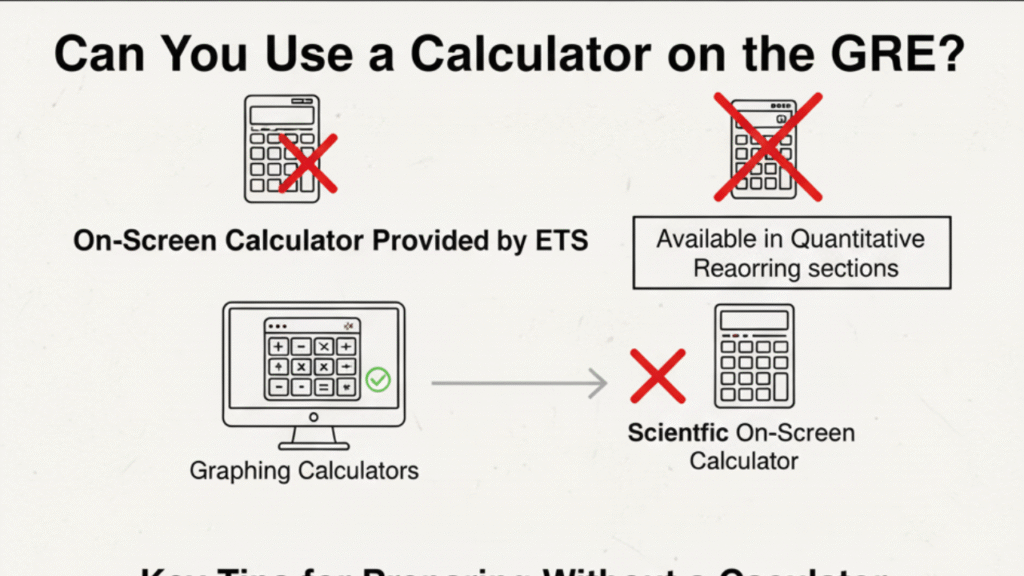
The short answer is yes, but only in specific sections. You cannot bring your own calculator to the GRE. However, the Educational Testing Service (ETS) provides an on-screen calculator during the Quantitative Reasoning section.
Functions of the On-Screen Calculator:
Addition
Subtraction
Multiplication
Division
This calculator is designed for basic arithmetic and does not include advanced features like graphing or scientific functions.
Can You Use a Graphing Calculator on the GRE?
No, you cannot use a graphing calculator on the GRE. The calculator provided by ETS is basic and does not have graphing capabilities. While graphing calculators are allowed in some exams (like the SAT), they are not permitted on the GRE.
If you’re accustomed to using a graphing calculator for your studies, you’ll need to adjust and rely on mental math and the on-screen calculator provided during the test.
Can You Use a Scientific Calculator on the GRE?
Similarly, you cannot use a scientific calculator on the GRE. The on-screen calculator is limited to basic functions such as addition, subtraction, multiplication, and division. If you need to perform scientific calculations (like trigonometric or logarithmic functions), you’ll need to do it manually or use your mathematical skills.
Can You Use a Calculator on the GRE at Home?
Yes! If you’re taking the GRE at home through the GRE at Home option, the calculator policy remains the same. You’ll have access to the on-screen calculator during the Quantitative Reasoning section, just like you would in an in-person test.
However, you cannot use your own calculator even if you’re taking the test from home. The only calculator allowed is the on-screen calculator provided by ETS.
Can You Use a Calculator on the Physics GRE?
The Physics GRE has a different policy. No calculators are allowed on the Physics GRE. Unlike the general GRE, you will have to rely on your knowledge of physics and mental math to solve the problems. This requires preparation and practice in solving physics problems without the aid of a calculator.
Tips for Preparing for the GRE Without a Calculator
Since calculators are only allowed during the Quantitative Reasoning sections, here are some tips to help you succeed:
1. Master Mental Math
Since you won’t always have a calculator, practice mental math for basic arithmetic like addition, subtraction, multiplication, and division. The faster you can do these in your head, the better your chances of success.
2. Learn Key Formulas
Memorize essential formulas for geometry, algebra, and statistics. The GRE tests your ability to apply formulas efficiently under time pressure. Knowing them by heart will help you solve problems quickly.
3. Use Estimation
When precision isn’t critical, use estimation techniques to save time. Estimating your answer before solving the problem helps you check if your final result is reasonable.
4. Practice with the On-Screen Calculator
If you’re planning to take the test online or in person, practice using the on-screen calculator available in the ETS GRE practice tests. Familiarity with the tool will save you valuable time on test day.
5. Focus on Time Management
GRE questions are designed to test your ability to solve problems under time constraints. Practice pacing yourself to ensure you can complete all questions within the given time.
Why Is the GRE Calculator Policy Like This?
The GRE calculator policy aims to test your problem-solving skills and mathematical reasoning. By restricting the calculator options, the GRE ensures that test-takers are assessed on their fundamental math abilities. The goal is to measure how well you can apply mathematical concepts, not how well you can use a calculator.
Conclusion: Can You Use a Calculator on the GRE?
To recap, you can use a calculator on the GRE, but only during the Quantitative Reasoning sections, using the on-screen calculator provided by ETS. Graphing calculators, scientific calculators, and personal calculators are not permitted.
Preparing without a calculator requires practice. Focus on mastering mental math, memorizing key formulas, and managing your time efficiently to ensure you’re ready for test day.